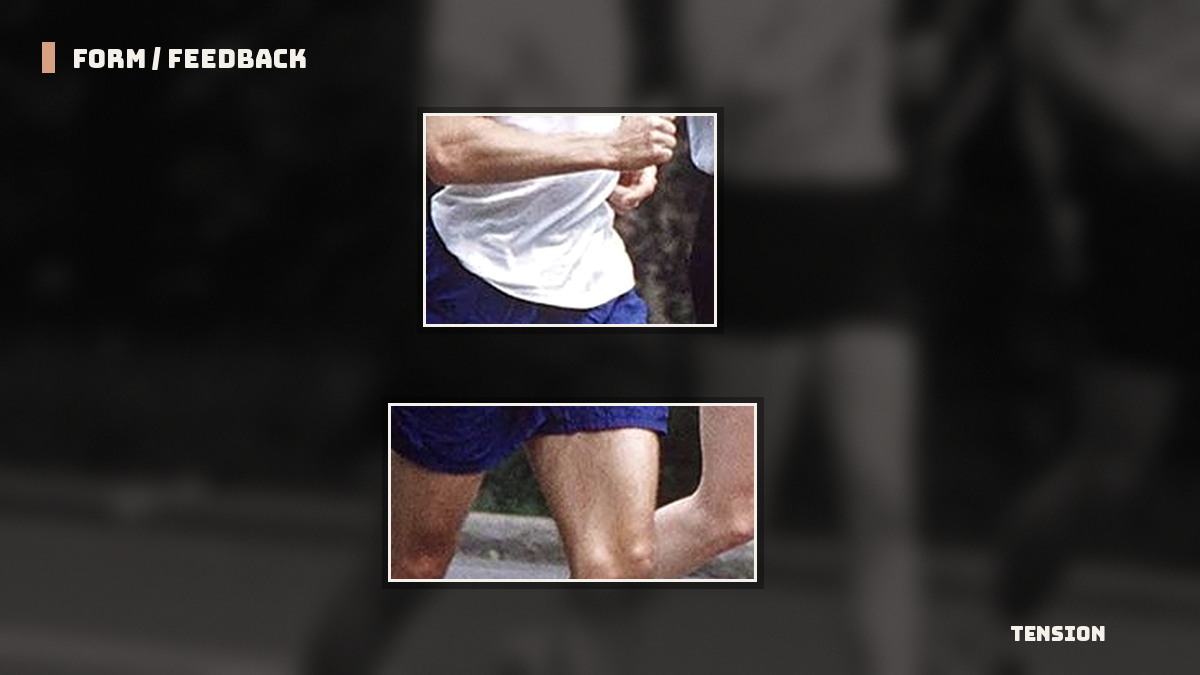
Runners hear a lot of form advice: increase cadence, reduce bounce, land differently, stay tall, stiffen the leg, relax the arms. Some of it may help some people. Some of it may do very little. Some of it may make a runner less comfortable if it is forced too aggressively.
A 2024 systematic review and meta-analysis in Sports Medicine gives a useful way to separate signal from noise. Van Hooren and colleagues reviewed 51 observational studies with 1,115 participants to ask which running biomechanics were associated with running economy during level, constant-speed, submaximal running.
What is running economy?
Running economy is the oxygen or energy cost of running at a given steady speed. If two runners are moving at the same pace, the more economical runner uses less oxygen or energy to hold that pace.
That makes running economy important for endurance performance, but it is not the same thing as comfort, resilience, pain, or injury risk. A runner can be economical and still have symptoms. A runner can also feel better after a change that does not show up as a large economy gain in a lab.
The study at a glance
- Design: systematic review and meta-analysis of observational studies
- Search: three databases monitored up to April 2023
- Included studies: 51
- Participants: 1,115 total, including 904 males and 227 females as reported in the review
- Population: healthy humans aged 18 to 65, mostly runners or physically active participants
- Task: level, constant-speed, submaximal running
- Main question: which biomechanical variables were associated with oxygen or energy cost
The authors assessed risk of bias and interpreted certainty with GRADE. They meta-analyzed an outcome when at least two studies reported the same variable. This matters because single small biomechanics studies can be noisy; the review tried to combine evidence while still flagging uncertainty.
Which common form cues were not strongly linked?
Several popular running-form metrics had trivial or non-significant associations with running economy in the pooled results.
- Ground contact time: r = -0.02, 95% CI -0.15 to 0.12
- Flight time: r = 0.11, 95% CI -0.09 to 0.32
- Stride time: r = 0.01, 95% CI -0.48 to 0.50
- Duty factor: r = -0.06, 95% CI -0.18 to 0.06
- Stride length: r = 0.12, 95% CI -0.13 to 0.36
- Swing time: r = 0.12, 95% CI -0.13 to 0.36
The review also found non-significant and often trivial associations for ankle, knee, and hip angles at selected points in the gait cycle, joint range of motion, peak vertical ground reaction force, mechanical work variables, and electromyographic muscle activation.
For runners, this is a useful caution. A watch metric or a video still can be interesting, but it should not automatically become a target. A number that looks tidy is not always a meaningful lever.
What did show a relationship?
Three findings stood out more clearly, although the associations were still modest.
- Higher cadence was associated with lower oxygen or energy cost: r = -0.20, 95% CI -0.35 to -0.05
- Smaller vertical displacement was associated with lower oxygen or energy cost: r = 0.35, 95% CI 0.19 to 0.49
- Higher vertical stiffness and leg stiffness were associated with lower energy cost: r = -0.31 and r = -0.28, respectively
The direction of these results broadly fits common coaching language: avoid excessive overstriding, avoid wasting motion upward, and use elastic tissue efficiently. But the size of the correlations matters. The authors concluded that individual biomechanical variables explained about 4% to 12% of the between-runner variation in running economy when considered alone.
Why cadence advice needs care
Cadence is one of the easiest variables to change, which is why it often becomes the headline. In this review, higher stride frequency had a small significant association with better running economy. The authors also noted that changing stride frequency has improved running economy in some intervention studies.
But small does not mean irrelevant, and significant does not mean universal. A runner who is overstriding may respond well to a small cadence increase. A runner who already self-selects an efficient rhythm may not need the same cue. A sudden large cadence change can also shift loading and sensation into different areas.
A more practical approach is to treat cadence as one experiment, not a rule. If a qualified coach or clinician suggests a change, make it gradual, record how it feels, and watch whether symptoms move, settle, or increase over the next sessions.
The vertical-bounce finding is useful, but not simple
Smaller vertical displacement showed a moderate association with lower energy cost. That sounds intuitive: if too much energy goes upward, less is available to move forward.
The trap is turning that into an instruction to run stiff, flat, or guarded. The same review found that leg and vertical stiffness related to economy, but individual joint stiffness at the knee and ankle was not clearly associated. In other words, the whole-body spring-like pattern may matter more than locking down one joint.
For everyday runners, the useful question is not whether the body is perfectly economical in a lab. It is whether a change in stride, shoe, surface, speed, fatigue, or training load is followed by a repeatable change in body sensation.
What the study cannot tell us
- The included studies were observational, so the review can identify associations but cannot establish causation.
- The findings are about running economy, not diagnosis, injury prevention, pain treatment, or return-to-run decisions.
- Many included samples were small, and the review included far more male than female participants.
- Running speed, footwear standardization, economy units, and lab methods differed across studies.
- A form variable that is not associated with economy may still matter for comfort, performance, or injury risk in an individual runner.
- The review does not replace assessment by a qualified professional when pain is persistent, worsening, or follows a significant injury.
What runners should take from this
The best takeaway is not to ignore form. It is to stop treating form as a single ideal shape. Running economy appears to be influenced by a mix of cadence, vertical motion, stiffness, tissue properties, training history, speed, footwear, fatigue, and individual anatomy.
- Be cautious with universal form rules, especially when they are based on one number.
- Use small experiments rather than abrupt technique overhauls.
- Track how a change feels during the run, later that day, and the next morning.
- Notice whether sensations appear in the same zone or shift to a new zone.
- Seek qualified guidance for persistent pain, escalating symptoms, or return after injury.
This is especially important because a more economical stride is not automatically the safest stride for a given runner on a given day. The review itself notes that optimal performance may require more than minimizing energy cost, and variables not associated with running economy may still be relevant to performance or injury prevention.
From form data to body feedback
A cadence number or video clip can tell you something about movement. It does not tell the whole story of how your body responded. That is where consistent self-report becomes useful.
With TENSION, runners can paint the exact area that felt tense, sore, heavy, or irritated on a 3D body map, record intensity, save the session, and compare it later with other runs. That makes technique experiments easier to interpret without pretending the app can diagnose the cause.
- Map the zone after a cadence, shoe, surface, hill, or speed change.
- Record intensity close to the run and again during recovery.
- Compare whether the same calf, knee, hip, lower back, or foot area keeps returning.
- Look for patterns across training blocks rather than reacting to one session.
- Bring a clearer history to a physiotherapist, doctor, coach, or other qualified professional.
Read the study - Van Hooren B, Jukic I, Cox M, Frenken KG, Bautista I, Moore IS. The Relationship Between Running Biomechanics and Running Economy: A Systematic Review and Meta-Analysis of Observational Studies. Sports Medicine. 2024;54:1269-1316.
Connect form experiments to body feedback
Learn what to note about training context and recurrence, compare this review with the marathon runner knee study, and see how to prepare a clearer professional conversation.
Explore TENSION's sports pain app for runners